How to Learn Harmonies by Ear
Most harmony lines are the next chord tone above or below the melody. Find the chord, and you've found the note.
Learning a harmony by ear means hearing the second vocal line that moves with the melody, and singing it yourself without sheet music. The usual harmony sits a third above or below the tune, built from the notes of the chord underneath. This guide gives singers a method that works on real records: isolate the vocals, loop and slow one line, catch the long notes, check them against the chord — and it's honest about what a vocal stem can and can't separate.
Riffloop isolates the vocals, loops and slows the line with the pitch held, and shows the chord under each note — free to start, on your device. Also on iPhone and Android.
Last updated · maintained by the Riffloop team
Learning Harmonies by Ear, at a Glance
To learn a harmony by ear, know the melody first, isolate the vocals, loop one line and slow it down, then hum the harmony note by note — starting with the long held notes — and check each one against the chord. The harmony is usually the chord tone just above or just below the melody.
- 🎵 Melody first — you can't harmonise a tune you're still learning
- 🔺 Start with a third above or below the melody
- 🎹 Harmony notes come from the chord underneath
- 🔁 Loop one line at about 75% speed, pitch held
- ⏳ Catch the long held notes first, then fill in
- ⚠️ A vocal stem holds lead and backing vocals together
What Is a Vocal Harmony?
A vocal harmony is a second line sung at the same time as the melody, on different notes that fit the same chord. Most pop, country, folk and worship harmonies move alongside the tune at a steady distance — usually a third — so they rise and fall with it.
Three kinds of motion cover most of what you'll hear. Parallel harmony follows the melody's shape at the same distance — the easiest to learn. Static harmony holds one note, or a few, while the melody moves around it — common in backing "oohs". Contrary motion goes down as the melody goes up — rarer in pop, and the hardest to hold. Before you learn any part, decide which of these you're listening to; it tells you what to expect from the next note.
Harmony on this page means singing a second vocal line. It assumes you can already sing the melody — if you need to work a tune out note by note first, see how to transcribe music by ear. If you want the chords themselves — the harmony a guitarist or pianist plays — that's a different job: see how to find the chords of a song.
Thirds Above and Below the Melody
A third above the melody is two letter names up — C to E, D to F — and a third below is two letter names down — C to A. Inside a key, thirds are three or four semitones wide, and they're the most common harmony interval because they almost always sound sweet against the chord.
The table shows thirds in the key of C major, using only the notes of the key. That's the point: a harmony stays in the key, so some thirds are major (four semitones, C to E) and some are minor (three semitones, D to F). Skip a letter, stay on the white keys, and you've got it (background: the third as an interval).
| Melody note | Third above | Third below |
|---|---|---|
| C | E | A |
| D | F | B |
| E | G | C |
| F | A | D |
| G | B | E |
| A | C | F |
| B | D | G |
A sixth below lands on the same note name as a third above, an octave lower — so a lower voice can take a "third above" part down the octave. Fifths sound open and hollow; use them for a moment, not a whole line, because a run of parallel fifths sounds bare. Unison and octaves aren't harmony at all — they thicken the melody.
The Chord-Tone Method for Finding a Harmony
The chord-tone method finds a harmony note in two looks: what note is the melody singing, and what chord is under it? The harmony above is the next note of that chord upward from the melody; the harmony below is the next one downward. It fixes the cases where a straight third would clash.
| Chord | Chord tones | Harmony above | Harmony below |
|---|---|---|---|
| C major | C · E · G | C → E · E → G · G → C | C → G · E → C · G → E |
| F major | F · A · C | F → A · A → C · C → F | F → C · A → F · C → A |
| G major | G · B · D | G → B · B → D · D → G | G → D · B → G · D → B |
| A minor | A · C · E | A → C · C → E · E → A | A → E · C → A · E → C |
A worked example
The chorus goes C major for a bar, then G major. Over the C chord the melody sings E, then G. The harmony above: E → G, then G → C. Now the chord moves to G and the melody lands on D: the next G-chord tone up from D is G. So your line is G, C, G — mostly thirds, with one fourth where a third (G up to B) would have sat awkwardly against the C chord. That one exception is why following the chord beats following a rule.
Where the chords come from
You can work them out by ear, or let Riffloop show them: it detects the chord playing under each moment of the song, with the key, on YouTube, in the Studio and in the apps — see the chord finder. Detected chords are estimates, at the major and minor level, so if a harmony note sounds wrong against what's shown, trust your ear and re-check the chord. Notes in a melody that pass quickly between chord tones don't need a harmony note each — harmonise the notes that land on the beat and are held.

A real capture from the Riffloop Android app: the detected key and tempo above the chord playing now — the chord tones your harmony is built from.
How to Learn a Harmony From a Recording: 7 Steps
To learn a harmony from a record, take the band away so only the voices remain, loop one chorus line, slow it to about 75%, and hum the harmony note by note from the long held notes backwards. Check each note against the chord, then sing it with the lead quiet, then with no lead at all.
- Learn the melody cold. Sing the tune until you could do it without the record. You can't hold a harmony against a melody you're still learning.
- Isolate the vocals. Take the band away so only the voices are left. The lead and the backing vocals stay together, but the harmony is no longer hiding under guitars and keys.
- Loop one line. Set an A-B loop around a single chorus line — four to eight seconds. Choruses are where harmonies usually live.
- Slow it down. Drop the loop to about 75% with the pitch held, so each harmony note lasts long enough to hum.
- Catch the long notes first. Hum the harmony on the held note at the end of the line, check it on a keyboard, then work backwards one note at a time.
- Check each note against the chord. Read the chord under each note. The harmony is usually the chord tone just above or just below the melody.
- Sing it against the record. Sing with the vocals turned down to a quiet guide, then with the vocals muted and only the band, then back at full speed.
Doing it in Riffloop
The method works with any looper; in Riffloop it looks like this. Open the song on YouTube with the extension, or in the Studio or the iPhone and Android apps; keep only the vocals with the vocal remover; set an A-B loop around the line; and drag the speed to 75% — the pitch stays where it is, so the notes you hum are the real ones (more on slowing a song down without changing the pitch). For step seven, turn the vocals down to around 20–30% instead of off, so the lead is a guide you can lean on; then pull it to zero and sing your part over the band.
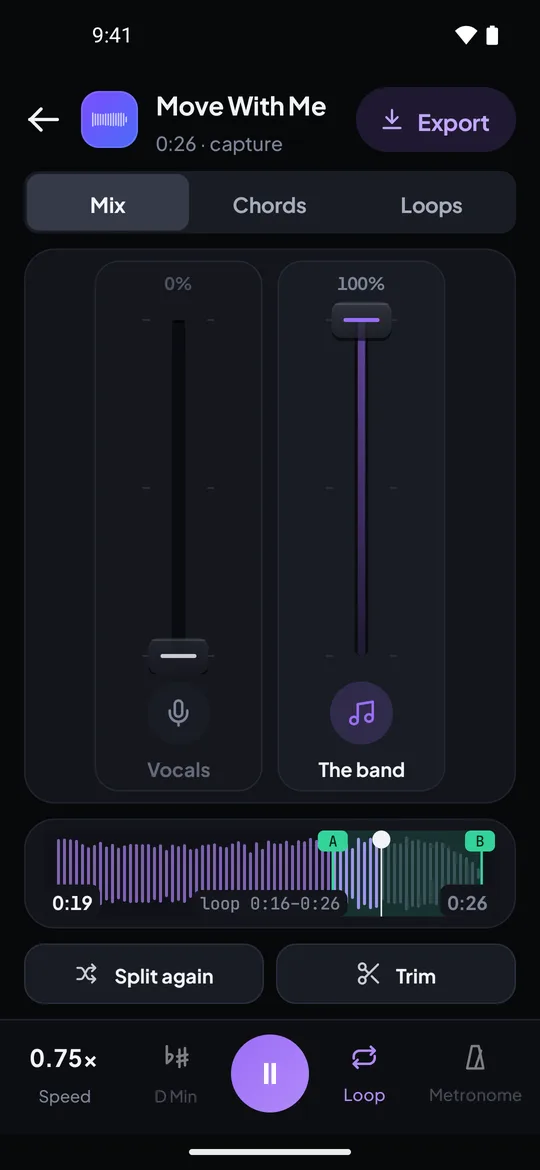
A real capture from the Riffloop Android app: a looped line at 0.75× speed, with the vocal faded so you can sing over the band.
Finding the harmony voice in the stack
With the instruments gone, listen for the voice that isn't singing the tune you learned. It's usually quieter than the lead, often higher, sometimes a different singer altogether. On headphones, try each ear: backing vocals are often mixed away from the centre while the lead sits in the middle. Hum along with the lead first, then deliberately hum a note above it on a held syllable and adjust until it locks — you'll feel the beating stop when you're on the note.
What a Vocal Stem Can and Can't Do for Harmony
A vocal stem gives you all the singing without the band, which makes harmonies far easier to hear. It does not split the lead from the backing vocals, or one harmony voice from another — Riffloop keeps them together in one vocal stem. You still pick the harmony out by ear.
| Job | Riffloop | Other route |
|---|---|---|
| Hear the voices without the band | Yes — vocal stem, on your device | Headphones and patience |
| Loop one line and slow it, pitch held | Yes — A-B loop, slow-down with pitch held | Any looper with time-stretch |
| See the chord under each note | Yes — detected chords and key | A chord chart |
| Move the song into your range | Yes — ±12 semitones, tempo kept | A capo or a transposed chart |
| Sing over the band with the vocal off | Yes — vocals to 0% | A karaoke track |
| Separate lead from backing vocals | No | An official multitrack, if one exists |
| Isolate one harmony part | No | Choir learning tracks, a vocal score, a teacher |
Two more things to expect. On songs built on dense stacks of harmony, the separated vocal can carry a little ghost of the instruments, and close harmonies blur together more than a solo voice does. And when one singer double-tracks their own harmony, the two parts share a tone, which makes them harder to tell apart than two different singers.
Songs With Harmonies That Are Easy to Hear
Start with duets and two-part harmony where the voices sound different and the harmony moves with the melody. Male–female duets are easiest, because you can tell the parts apart by tone; close sibling harmony and three-part stacks come later.
- 1 Kenny Rogers & Dolly Parton — Islands in the Stream: two very different voices; the chorus harmony is easy to follow.
- 2 Simon & Garfunkel — The Sound of Silence: two voices moving together through slow, steady lines.
- 3 The Everly Brothers — All I Have to Do Is Dream: classic close harmony at a gentle tempo.
- 4 The Beatles — If I Fell: two-part harmony almost all the way through.
- 5 Crosby, Stills & Nash — Helplessly Hoping: three-part harmony — a stretch goal once two parts feel easy.
Pick the part that suits your voice, not the one you like best. And start with the chorus — that's where most records put their harmonies, and where they're loudest.
Three Ear Drills for Harmony Singers
Three short drills build the ear that harmony needs: a third ladder to learn the sound of thirds in a key, a held-note drill to stay on your note while the melody moves, and a switch drill to jump between melody and harmony on the same line. Five minutes each, with a keyboard or a looped song.
- The third ladder. Play C on a keyboard and sing E; play D and sing F; carry on up the scale of C (the table above has every pair). Then do it without the keyboard and check only the top note. You're learning what a third in the key feels like, major and minor.
- The held-note drill. Loop a slow chorus line and hold one note of its first chord — the third of the chord is a good choice — for as long as that chord lasts, while the record's melody moves around you. This is static harmony, and it trains you not to follow the tune.
- The switch drill. On one looped line, sing the melody on the first pass and the harmony on the second, and keep alternating. When the switch feels effortless, you know both parts — and you'll stop drifting from one to the other.
When there are three voices
In a three-part stack, find the top voice and the bottom voice first — they're the easiest to hear. The middle part is usually the chord tone that's left over. Hum it against the record and adjust until the chord sounds full. Close three-part harmony is genuinely hard to pick apart from a recording, so expect it to take several sessions.
A 20-Minute Harmony Practice Session
Twenty focused minutes on one line works better than an hour on a whole song. Warm up, find the notes, drill the line slowly, then sing it against the lead and against the band alone.
- Minutes 0–3: warm up. Hum and slide gently through your range.
- Minutes 3–8: find the notes. Loop one chorus line with only the vocals, at 75%. Hum the harmony note by note and check each on a keyboard or against the chord.
- Minutes 8–13: drill it slowly. Sing the harmony with the vocals at about 25%, five clean passes in a row before you move on.
- Minutes 13–17: lose the guide. Mute the vocals and sing your part over the band. Then bring the speed up in 5–10% steps.
- Minutes 17–20: record and check. Record a pass on your phone with the lead back in. Listen once; note the one note that drifts for tomorrow.
If the harmony sits too high or low for you, change the song's key a few semitones — the whole song moves, so the harmony keeps its place against the melody. To work out how far, use how to find your vocal range.
Common Harmony-Singing Mistakes
Most harmony trouble comes from learning too much at once and listening too little: not knowing the melody, guessing from the full mix, and singing over the top of the lead.
- Learning the harmony before the melody. You'll have nothing to hold it against.
- Guessing from the full mix. Guitars and keys sit right where harmonies live. Take them out first.
- Sticking to a third no matter what. When it clashes, move to the next chord tone.
- Drifting onto the melody. Learn your line alone first, then bring the lead back in quietly.
- Singing louder than the lead. A harmony supports; keep it a little under the melody, with less vibrato.
- Learning the whole song at once. One line at a time, at a slower speed, until it's automatic.
- Expecting the separated vocal to split the parts for you. It removes the band; your ear still picks the harmony voice.
Harmony Singing — FAQ
What singers ask about learning harmonies by ear: finding the note, thirds, drifting onto the tune, separating backing vocals, practising alone, and choosing the key.
How do you learn harmonies by ear?
Learn the melody first, then isolate the vocals so the harmony isn't buried under the band, loop one short line and slow it down with the pitch held. Hum the harmony voice one note at a time, starting with the long held notes, and check each one against the chord underneath. Then sing it against the record, first with the vocal quiet, then with the band alone.
How do you find the harmony to a song?
Start from the melody note and the chord under it. The harmony is usually the next note of that chord above the melody, or the next one below. If the chord is C major (C, E, G) and the melody sings E, the harmony above is G and the harmony below is C. Move to the next chord and do the same.
Is harmony always a third above the melody?
No, but a third above or below is the most common starting point, especially in pop, country and worship music. When a straight third would clash with the chord, the harmony usually moves to a different chord tone instead — sometimes a fourth above, sometimes a sixth below. Following the chord matters more than keeping one fixed interval.
How do I stop drifting onto the melody when I sing harmony?
Learn your harmony line alone until it's solid, then add the melody back quietly and turn it up a little at a time. Singing against a looped line at a slower speed helps, and so does putting a hand over one ear so you hear your own voice clearly. Drifting is normal at first; it's a listening skill, and it gets easier with reps.
Can I separate the backing vocals from the lead vocal?
Not with Riffloop. Its vocal stem keeps the lead and the backing vocals together, because separation works on the singing as a whole rather than on each voice. With the band removed, though, harmonies are much easier to hear than in the full mix. For a part on its own, look for choir learning tracks, an official multitrack, or a teacher who can sing it for you.
How do I hear the backing vocals in a song?
Take the instruments away so only the voices are left, then loop a chorus and listen for the voice that isn't singing the tune — it's usually higher or lower, often softer, sometimes a different singer. On headphones, backing vocals are often panned away from the centre, so one ear can hear them more clearly. Long held notes at the end of a line are the easiest place to catch them.
Do I need perfect pitch to sing harmony?
No. Harmony singing uses relative pitch — hearing how one note sits against another — and that can be trained. A keyboard or piano app to check your notes, and a lot of slow, looped practice, will take you further than perfect pitch would.
What is the easiest harmony to sing?
A harmony that moves in parallel with the melody, a third above or below, on a slow song you already know well. Duets where the two singers have very different voices — a man and a woman, for example — are easiest to start with, because you can tell the parts apart by tone.
Should I sing harmony above or below the melody?
Sing where your voice is comfortable. A higher voice than the lead singer usually takes the part above, a lower voice the part below. If the melody already sits high in your range, the harmony below is the safer choice. Try both on one line and keep the one you can hold without straining.
How can I practise harmonies on my own?
Use the record as your partner. Turn the vocals down rather than off so the lead is a quiet guide, loop one chorus line and sing your harmony against it until it's steady. Then mute the vocals and sing the harmony with only the band. Recording yourself on your phone and listening back shows exactly where you drift.
What key should I sing a harmony in?
A harmony stays in the song's key; what changes is whether it fits your voice. If the harmony line sits too high or too low for you, transpose the whole song a few semitones — the harmony moves with it. For working out your own range and the semitone shift, see how to find your vocal range.
What's the difference between harmony and backing vocals?
Backing vocals are any voices supporting the lead — they can be oohs, echoes of a line or the same tune in unison. Harmony means a different note sung at the same time as the melody. Many backing vocals are harmonies, but not all, so listen for whether the backing voice is on the melody note or another one.
How soon can a beginner sing harmony confidently?
It varies with how much you already sing, but short, regular sessions work best. Many singers find simple parallel thirds come within a few weeks of practising most days, while hearing a part inside a dense three-voice stack takes longer. Ten to twenty minutes a day on one song beats one long session a week.
Can I practise harmonies with a karaoke track?
Yes — a track with the lead vocal down is a good stage two, once you know the part. You'll sing your harmony without the lead holding your hand. Riffloop's YouTube karaoke maker keeps synced lyrics on the video while the vocal is down, which helps with the words.
If You Remember Four Things
- 1 Know the melody cold before you look for the harmony.
- 2 The harmony is usually the next chord tone above or below the melody.
- 3 Take the band away, loop one line at 75%, and catch the long notes first.
- 4 A vocal stem keeps lead and backing together — your ear does the last split.
Keep Going With Riffloop
Take the Band Away. Find the Third.
Open the song on YouTube, keep just the voices, loop one chorus line at 75% and hum the note above the tune — then sing it over the band. Three songs as a guest, no account.

