How to Find Your Vocal Range
Your range is half the answer. The other half is the song's own highest and lowest notes — and the number of semitones between them and you.
Your vocal range is the span from the lowest to the highest note you can sing cleanly. You can find it in ten minutes with a keyboard app. But knowing you're "a baritone, A2 to A4" doesn't tell you what key to sing a particular song in. For that you also need the song's range — and that part almost every vocal range test leaves out. This guide covers both, then shows the semitone sum that joins them.
Riffloop isolates the vocal, loops and slows the line, and moves the song up to twelve semitones either way — free to start, on your device. Also on iPhone and Android.
Last updated · maintained by the Riffloop team
Your Vocal Range, at a Glance
To find your vocal range, warm up, then match your lowest and highest clean notes on a keyboard. To find the right key for a song, find the song's highest note, count the semitones to your own top comfortable note, and move the song by that many.
- 🎹 Any keyboard, piano app or tuner app is enough to name your notes
- ✅ Count only notes you could hold for about three seconds without strain
- 🎯 Your comfortable range (tessitura) matters more than your extreme notes
- 🔝 The song's highest note is usually in the last chorus or the bridge
- 🔢 Shift = semitones from the song's top note to yours; then check the low end
- 🧑🎤 A man covering a woman's song: start five to seven semitones lower
How to Find Your Vocal Range
Warm up, then walk your voice down and up one note at a time against a keyboard, and write down the last note at each end you can sing cleanly. You need no special equipment — just a way to name the note you're on.
- Warm up for five to ten minutes. Hum, lip-trill or slide gently up and down. A cold voice tests low and short.
- Find your starting note. Speak "hey" at a relaxed pitch, then sing it as "ah" and match it on a keyboard or tuner app. For most men it's around C3; for most women around C4 (middle C).
- Walk down. Step down one key at a time on "ah". Stop when the note goes breathy, crackly (vocal fry) or you can't hold it for about three seconds. Write down the last clean note — that's your bottom.
- Walk up. Go back to your starting note and step up. Write down two things: your top note in your normal chest or mixed voice, and, separately, your top falsetto or head-voice note.
- Mark your comfortable range. Sing a simple tune at the edges. The stretch you could sing a whole song in without tiring — usually a few notes inside each end — is the one you'll use for choosing keys.
- Repeat on another day. Range moves with sleep, health and warm-up. Two or three tests give you a number you can trust.
Write it like a singer would: lowest note to highest, in scientific pitch notation, where C4 is middle C. "A2 – F4, comfortable C3 – D4, falsetto to A4" tells you far more than "about two octaves".
Voice Types and Their Ranges
The six classical voice types are soprano, mezzo-soprano and alto for female voices, and tenor, baritone and bass for male voices. The ranges below are typical guides, not rules — sources differ by a note or two, and plenty of singers sit between two types.
| Voice type | Typical range | Notes |
|---|---|---|
| Soprano | C4 – C6 | Highest female voice; bright top |
| Mezzo-soprano | A3 – A5 | Middle female voice |
| Alto / contralto | F3 – F5 | Lowest female voice; sources vary on the bottom note |
| Tenor | C3 – C5 | Highest common male voice |
| Baritone | A2 – A4 | Most common male voice; sources vary most here |
| Bass | E2 – E4 | Lowest male voice |
Countertenors — men singing mostly in head voice — overlap the alto range. And a voice type is decided as much by tone and comfort as by notes: a baritone who can hit a tenor's top note is still a baritone if that's not where his voice lives.
Range vs Tessitura
Your range is every note you can make; your tessitura is the part of it where your voice is comfortable and sounds its best. Tessitura is what decides whether a song suits you, because a melody spends most of its time in one zone, not at the edges.
Two songs with the same top note can feel completely different: one touches the note once, the other sits a tone below it for the whole chorus. That's why matching a song only to your highest note can still leave you tired by the second chorus — check where the song spends its time, too. As a rule of thumb, put the song's busiest stretch in your comfortable range and let only the peak notes reach towards your top.
Find the Song's Highest and Lowest Notes
To find a song's range, isolate the vocal so you hear the melody alone, loop the highest and lowest lines, slow them down with the pitch held, and match each note on a keyboard. The highest note is usually in the last chorus or bridge; the lowest is usually in the first verse.
- Isolate the vocal. Load the song in Riffloop and keep only the vocal stem with the vocal remover, so the melody isn't hiding under guitars and synths. On YouTube it works on the video itself.
- Loop the peak. Set an A-B loop over the line you think is highest. Listen to the last chorus and the bridge before you decide — songs save the top note for late.
- Slow it down. At 50–75% speed, with the pitch held, a fast run turns into notes you can hum one by one. See slowing a song down without changing pitch.
- Match the note. Hum the top note and find it on the keyboard or tuner. Write it down — say, A4.
- Repeat for the lowest line. Usually the opening of the first verse. Write that down too — say, C4.
- Note the key. Riffloop also detects the song's key, so you know where you started before you move it — see the key and BPM finder.
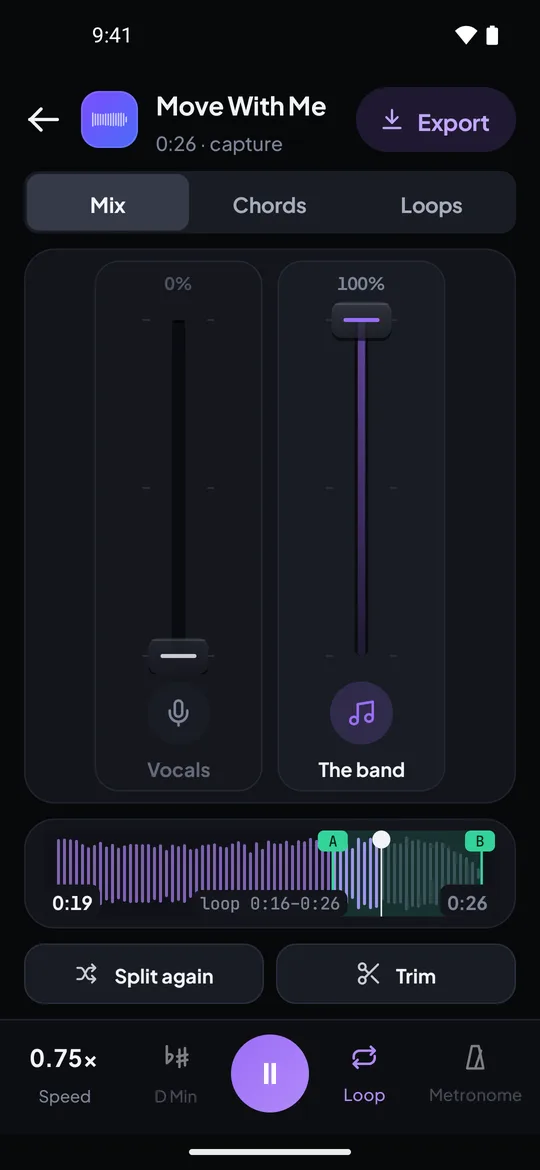
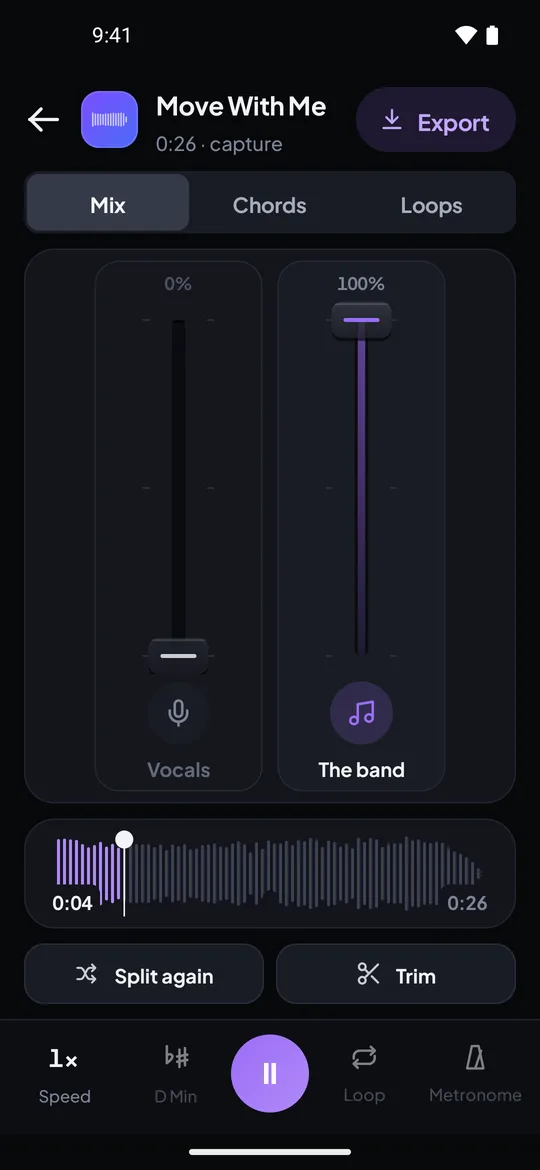
Real captures from the Riffloop Android app: a looped line at 0.75× speed, and the vocal faded against the band.
Count the Semitones, Then Move the Song
The shift you need is the number of semitones from the song's highest note to your highest comfortable note. Move the song by that much — down if it's above you, up if it's below — then check that its lowest note still fits.
A semitone is one key on a keyboard, white or black. Use the table to count: give each note its number, and the difference is the number of semitones. Crossing from B up to C adds twelve to the higher note.
| Note | Number |
|---|---|
| C | 0 |
| C♯ / D♭ | 1 |
| D | 2 |
| D♯ / E♭ | 3 |
| E | 4 |
| F | 5 |
| F♯ / G♭ | 6 |
| G | 7 |
| G♯ / A♭ | 8 |
| A | 9 |
| A♯ / B♭ | 10 |
| B | 11 |
Semitone calculator
Pick the song's highest note and your highest comfortable note.
Move the song down 4 semitones.
A worked example
The song runs from C4 up to A4. Your comfortable top is F4, your bottom A2. A is 9 and F is 5, so the song's top is four semitones above yours: move the song down 4. Its low note C4 drops to G♯3 — well inside your range. Sing the last chorus at −4; if it's comfortable but flat-sounding, try −3.
If the song's range is wider than yours
When the song spans more than your comfortable range, no single key fixes both ends. Protect the top — a strained high note is more noticeable than a quiet low one — or, for a line that drops very low, sing just that phrase up an octave at a natural break.
Then make the move in Riffloop's key changer: up to twelve semitones either way, with the tempo unchanged. To sing the whole thing through with the vocal down and synced lyrics on the video, use the YouTube karaoke maker.
Singing a Song Written for Another Voice
When a man covers a song sung by a woman, start about five to seven semitones lower and adjust by ear; for the reverse, start about five to seven higher. A full octave is usually too far — the song ends up sitting too low to have any energy.
- ⬇️ Man covering a woman's song: try −5, −6 and −7, and keep the one where the chorus has lift without strain.
- ⬆️ Woman covering a man's song: try +5 to +7, or sing it in the original key an octave up if it's a low song.
- ⛪ Leading a group: worship leaders often reckon female leads sit about a fifth above male ones — pick a key the room can sing, not just the leader.
- 🎸 Playing as well as singing: once you know the new key, a capo or the transposed chord shapes keep the guitar easy.
Common Vocal Range Mistakes
Most wrong answers come from testing badly, not from the voice: testing cold, counting strained notes, and judging a song on its verse.
- Testing cold. A voice tested first thing in the morning or without a warm-up reads lower and shorter than it really is.
- Counting the squeak. If you couldn't sing it in a song, it isn't in your working range.
- Mixing falsetto into the top. Keep your top chest or mixed note and your top falsetto note as separate numbers.
- Choosing the key on the verse. Verses sit low in almost any key; the chorus and bridge decide.
- Matching only the top note. Check where the song spends its time, and that the low end still fits after the move.
- Chasing a voice-type label. The label matters less than the notes you sing well.
When to Get Help
See a voice teacher if notes crack at the change between registers or you want to grow your range safely. See a doctor if singing hurts, your voice disappears suddenly, or you're hoarse for more than about four weeks.
Cracking around the change from chest to head voice is a coordination skill, and a teacher can usually help with it quickly. Pain is different: don't push through it. US ear, nose and throat guidelines recommend having the voice box examined when hoarseness lasts beyond four weeks, or sooner if something serious is suspected (summary of the 2018 guideline). This page is practice advice, not medical advice.
Vocal Range — FAQ
What singers ask about vocal range: what's good, tenor or baritone, falsetto, online tests, a song's highest note, and covering a song by another voice.
How do I find my vocal range?
Warm up for five to ten minutes, then sing an easy note on an open vowel and match it on a keyboard or a piano app. Step down one key at a time until you can't hold a note for about three seconds without strain or vocal fry, and write down the last clean one. Do the same going up. Those two notes are your range; the stretch you can sing all day is your comfortable range.
What is a good vocal range?
There's no single good number: a song only needs the range it uses, and most pop melodies sit inside about an octave and a half. Many untrained adults have somewhere around one and a half to two octaves, and trained singers often have more. What matters more for choosing songs is your comfortable range, where your voice sounds best.
Is two octaves a good vocal range?
Yes — two octaves is a useful working range that covers the melody of most popular songs, as long as the song is in a key that puts it in the right part of your voice. Most singing problems come from songs sitting in the wrong place, not from too small a range.
What's the difference between vocal range and tessitura?
Range is every note you can produce, from lowest to highest. Tessitura is the part of that range where your voice is most comfortable and sounds best, and it is what really decides which songs, and which keys, suit you. A singer with a huge range can still have a fairly narrow tessitura.
How do I know if I'm a tenor or a baritone?
Compare your comfortable range with the voice-type table: tenors usually sit around C3 to C5, baritones around A2 to A4. Tone and where your voice changes gear matter too — baritones tend to sound heavier and shift into head voice lower, tenors brighter and higher. A voice teacher can tell you in a few minutes.
Are online vocal range tests accurate?
A microphone test can name the notes you sing quite reliably, but it can't tell whether a note was comfortable or strained, and it counts a squeaked top note the same as a solid one. Use it, or a keyboard, to find the notes, then judge the edges honestly yourself: only count notes you could sing in a song.
Does falsetto count in my vocal range?
It counts as part of your full range, but keep it separate when you match songs. A note you can only reach in a light falsetto won't carry a belted chorus, so note your top chest or mixed note and your top falsetto note as two different figures.
Can I find my vocal range without a piano?
Yes. A free piano or keyboard app on your phone works, and so does any tuner app, which shows the name of the note you are singing. You only need a way to name the note; the singing and the judgement are yours.
How do I find the highest note of a song?
Isolate the vocal so you hear the melody on its own, loop the line you think is highest — usually the last chorus or the bridge — and slow it down with the pitch held. Hum the top note and find it on a keyboard or tuner. Do the same for the lowest note, which is usually in the first verse.
How do I match a song to my vocal range?
Count the semitones from the song's highest note to your highest comfortable note, and move the song by that many: down if the song is higher than you, up if it's lower. Then check that the song's lowest note, moved by the same amount, still sits inside your range. If it doesn't, the song's range is wider than yours and you'll need to compromise.
What key should a man sing a woman's song in?
Start about five to seven semitones lower than the original and adjust by ear; worship leaders often work on the rule that female leaders sit roughly a fifth above male ones. Dropping a full octave usually makes the song sit too low to have any energy. Riffloop moves a song up to twelve semitones either way, with the tempo kept.
Can you increase your vocal range?
Usually a little, with regular, well-coached practice — mostly by making the top and bottom notes you already have usable rather than adding new ones overnight. Working on your comfortable range and on the break between registers tends to help songs more than chasing extra notes.
Why does my voice crack on high notes?
Most often it's the change between chest and head voice, where the voice switches gear; it's a coordination skill that a teacher can help with. If high notes hurt, or your voice is hoarse for more than a few weeks, stop pushing and see a doctor rather than a teacher.
Does my vocal range change during the day?
Yes. Most singers find their voice lower and stiffer just after waking, and range moves with tiredness, illness and how warmed up you are. Test after a warm-up, at the time you usually sing, and leave yourself a note or two of headroom when you choose keys.
If You Remember Four Things
- 1 Warm up, and count only the notes you could sing in a song.
- 2 Your comfortable range decides your keys, not your extreme notes.
- 3 Find the song's top note in the last chorus, then count the semitones to yours.
- 4 Covering another voice: start five to seven semitones away and adjust by ear.
Keep Going With Riffloop
Find the Top Note. Then Move the Song.
Open the song you want to sing on YouTube, keep just the vocal, loop the last chorus and find its peak — then drop the song into your range. Three songs as a guest, no account.

