How to Find the Time Signature of a Song
Find beat one. Count to the next beat one. That number — usually four, sometimes three — is most of the answer.
A song's time signature tells you how many beats are in each bar and how each beat divides. To find it by ear, tap along to the pulse, find the downbeat — beat one, where the music lands — and count the beats until it comes round again. Then listen inside each beat: two halves means 4/4 or 3/4; three means 6/8 or 12/8. This guide gives you the method, a decision guide for the confusing pairs, and songs to test yourself on.
Riffloop loops a few bars, slows them down with the pitch held and lets you solo the drums, so you can count without the rest of the band in the way — free to start, on your device. Also on iPhone and Android.
Last updated · maintained by the Riffloop team
Finding the Time Signature, at a Glance
To find the time signature of a song, find the steady pulse, find beat one, and count the beats until beat one comes back. Four is the most likely answer, then three. If each beat splits into three rather than two, the song is in a compound meter such as 6/8 or 12/8.
- 🦶 Pulse first: tap your foot to the drums and bass, not the melody
- 1️⃣ Beat one is where chords change and crashes land
- 🔢 Count to the next beat one, over eight bars, not one
- 🥁 A snare on 2 and 4 is the classic sign of 4/4
- 🌊 Beats that split in three: 6/8 or 12/8
- 🧩 Odd meters count as groups of 2s and 3s
This guide is about the meter only — how the beats group into bars. For how fast the beats go, use the key and BPM finder; for the chords and key, see how to find the chords of a song and how to find the key of a song.
What Is a Time Signature?
A time signature is the pair of numbers at the start of written music: the top number says how many beats are in a bar, the bottom number says which note value gets one beat — 4 for a quarter note, 8 for an eighth. By ear, what you actually hear is the number of beats per bar and whether each beat splits in two or in three.
That second part is the one most guides skip. Meters where each beat splits in two are called simple — 2/4, 3/4, 4/4. Meters where each beat splits in three are compound — 6/8, 9/8, 12/8. A song in 6/8 has two beats you'd tap your foot to, not six; the six is the count of the small notes inside them. The table shows the meters you'll meet most, how to count them, and songs commonly counted that way. Some transcriptions disagree — the same song can appear in 6/8 in one book and 12/8 in another — because it's partly a writing choice (for the notation side, see Wikipedia's time signature article).
| Meter | Count | How it feels | Where you hear it |
|---|---|---|---|
| 4/4 | 1 2 3 4 | Four even beats, each split in two; snare on 2 and 4 | Most pop and rock — Queen's Another One Bites the Dust, Michael Jackson's Billie Jean |
| 3/4 | 1 2 3 | A waltz: one strong beat and two lighter ones | Happy Birthday, Amazing Grace, Moon River, Piano Man |
| 6/8 | 1 2 3 4 5 6 | Two big, swaying beats, each split in three | The Animals' House of the Rising Sun, Queen's We Are the Champions |
| 12/8 | 1 2 3 4 5 6 7 8 9 10 11 12 | Four beats, each split in three: a shuffle or slow-blues roll | Slow blues and many soul ballads |
| 2/4 | 1 2 | Marches and polkas; sounds like half a bar of 4/4 | Marching-band music, some polkas and folk dances |
| 5/4 | 1 2 3 4 5 | Usually felt as 3 + 2 | Dave Brubeck Quartet's Take Five, the Mission: Impossible theme |
| 7/4 | 1 2 3 4 5 6 7 | Usually felt as 4 + 3 or 2 + 2 + 3 | Pink Floyd's Money, Peter Gabriel's Solsbury Hill (mostly) |
How to Find the Time Signature of a Song: 6 Steps
Find the pulse, find beat one, count to the next beat one, then confirm with the snare and with how each beat divides. Check across a whole verse and chorus before you decide — one bar can mislead you.
- Find the pulse. Tap your foot or nod along until you have a steady beat you could clap to. Ignore the melody for now; listen to the drums and bass.
- Find beat one. Listen for the landing: the chord change, the crash cymbal, the bass hitting a root note, the start of a phrase. That's the downbeat.
- Count to the next beat one. Count out loud from one downbeat to the next. Four is the most common answer, then three. Check over eight bars, not one.
- Check the snare. In most 4/4 songs the snare hits on 2 and 4. In a waltz it tends to sit on 2 and 3, or not at all. A snare that lands on your count confirms it.
- Check the subdivision. Listen inside each beat. Two even halves (1-and-2-and) means a simple meter such as 4/4 or 3/4; three (1-and-a-2-and-a) means compound, such as 6/8 or 12/8.
- Confirm across the song. Count through a verse, a chorus and the bridge. If the count suddenly comes up short or long, the song changes meter or adds an odd bar there.
Do this with a short loop rather than the whole song. Four to eight bars of the chorus, played round and round, gives you dozens of chances to land your count. If it's fast, slow the loop to 70–75% with the pitch held — see how to slow a song down without changing the pitch — and the beats spread out enough to count comfortably. Soloing the drums helps more than anything: with the guitars and vocal gone, the kick, snare and crash spell out the bar for you. On YouTube you can set the loop on the video itself — see how to loop a YouTube video in Chrome.
A worked example
You loop an eight-bar chorus at 75% and count 1-2-3-4 from the first crash. Bars one and two line up: the chord changes on your 1 and the snare hits your 2 and 4. By bar three the chord change has moved onto your 4. That means one of two things. Either you counted at the wrong level — try halving the count, and if the snare now sits on every beat 2 you were counting the hi-hat — or the bar is shorter than four. Count 1-2-3 from the same crash: if the chord now changes on every 1 for all eight bars and the drums lean on the first of each three, it's 3/4. If the threes come in pairs — strong, weak, strong, weak — with a swaying feel, count it as two big beats split in three: 6/8.
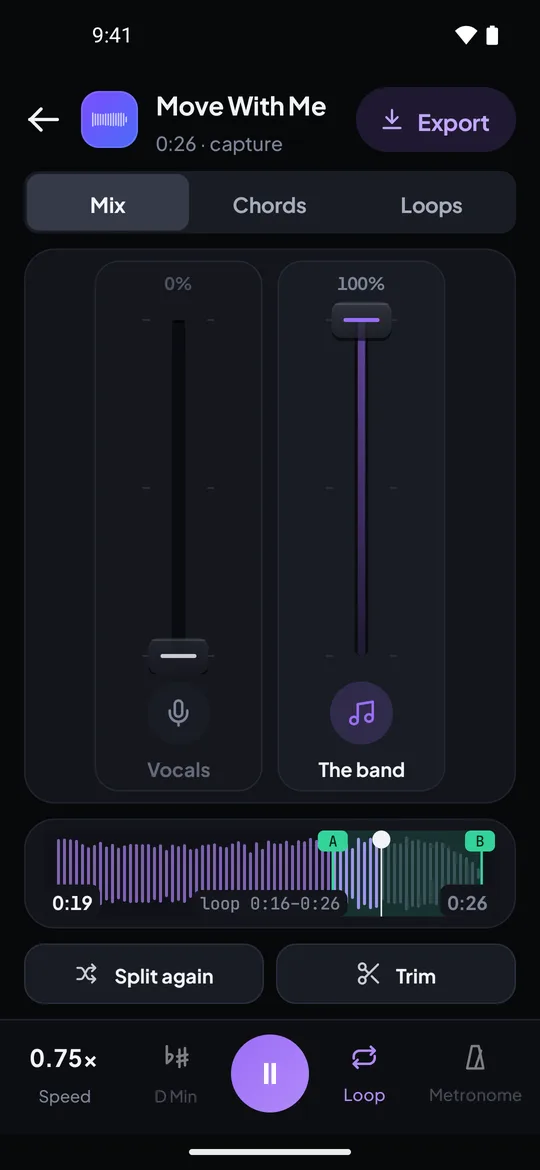
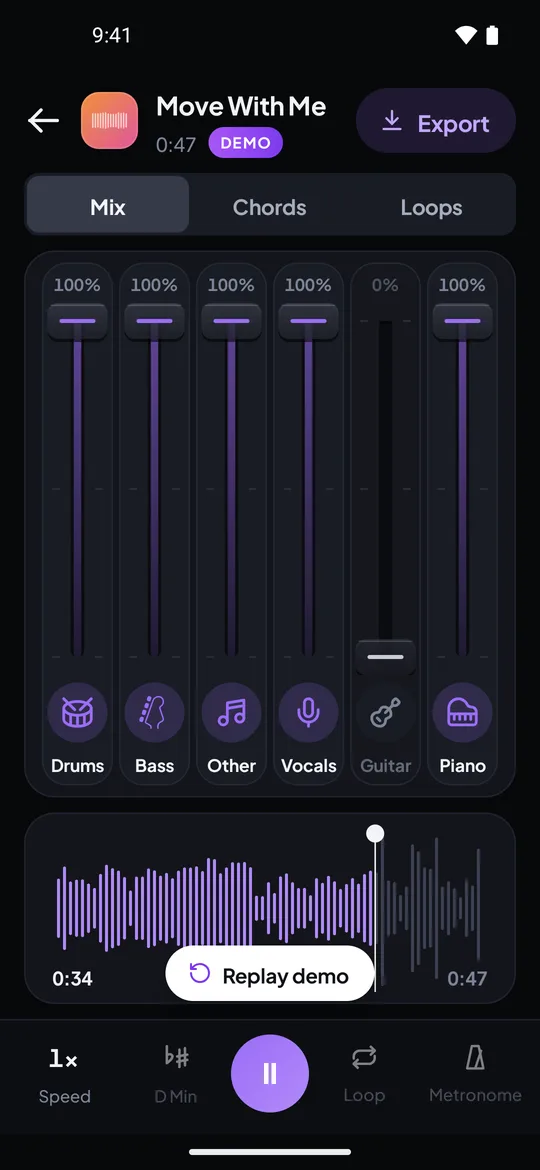
Real captures from the Riffloop Android app: a looped section at 0.75× speed, and the six-part mixer where you can leave only the drums and bass.
How to Find the Downbeat
The downbeat is beat one of the bar, and it usually sounds like a landing: chords change on it, crash cymbals and kick drums hit it, and phrases start on it. Find several of those landings in a row and count between them.
- 🎹 Chord changes. Harmony most often moves on beat one — and sometimes on beat three in 4/4.
- 💥 Crash cymbal. Drummers mark the start of a section with a crash on beat one.
- 🎸 Bass root note. The bass usually plays the chord's root on the downbeat — loud and low.
- 🎤 Phrase starts, with a catch. Vocal lines often begin with a pickup, a beat or two before beat one.
- 🦶 The kick. In most rock and pop the kick drum lands on 1, and the snare answers on 2 and 4.
- 🔁 The repeat. A riff or a four-chord loop starts again on beat one — count from its first note.
If two cues disagree — the singer starts on what feels like beat one but the chord changes a beat later — trust the chord change and the crash. Singers start early all the time; drummers and chord charts rarely put beat one anywhere else.
4/4, 3/4 or 6/8? Tell the Confusing Pairs Apart
Ask three questions in order: how many beats before beat one returns, does each beat split in two or in three, and where does the snare fall. Those three answers separate 4/4, 3/4, 6/8 and 12/8 in almost every song.
- Four beats, each split in two, snare on 2 and 4? 4/4. This is the answer for most songs you'll hear.
- Four beats, each split in three — a shuffle or a rolling slow-blues feel? 12/8, or 4/4 with a shuffle. Both describe the same feel.
- Three beats, each split in two — ONE-two-three? 3/4, a waltz.
- Two big beats, each split in three — ONE-and-a-TWO-and-a? 6/8. The song sways rather than waltzes.
- Nothing fits — you keep coming up one beat short or long? An odd meter such as 5/4 or 7/4, or a song that changes meter. See the next two sections.
The 3/4 vs 6/8 test
Both fill a bar with six eighth notes, which is why they're confused. Count the six out loud — 1-2-3-4-5-6 — along with the song. Now lean on 1, 3 and 5: if that fits, it's 3/4. Lean on 1 and 4: if that fits, it's 6/8. A body test works too: if you'd nod three times a bar, it's 3/4; if you sway side to side twice, it's 6/8.
The double-time trap
If your count feels frantic, you may be counting the hi-hat's eighth notes as beats; halve it. If it feels sluggish, you may be counting every other beat; double it. Pick the count you'd naturally clap at a gig. The tempo and the meter are separate questions — for the speed, read it off the key and BPM finder.
Odd Time Signatures: How to Count 5/4 and 7/4
Odd meters are counted as groups of twos and threes. 5/4 is usually felt as 3 + 2, and 7/4 as 4 + 3 or 2 + 2 + 3. If counting in four keeps landing you one beat early or late, the song is probably in five or seven.
- 5️⃣ 5/4 — try it on: the Dave Brubeck Quartet's Take Five and the Mission: Impossible theme. Count ONE-two-three-FOUR-five.
- 7️⃣ 7/4 — try it on: Pink Floyd's Money and, for most of the song, Peter Gabriel's Solsbury Hill. Count ONE-two-three-four-FIVE-six-seven.
The grouping is the secret. Listen for where the riff or the drums put their accents and count that shape, not a flat 1-to-7. Loop one bar, say the count out loud, and keep going until the bar stops feeling like a stumble. Bass players get a head start here: a repeating riff in an odd meter is one of the best ways to feel it in your hands — Money's riff is on our list of easy bass songs to learn by ear.
Songs That Change Time Signature
Plenty of songs change meter between sections or slip in one short bar. If your count is solid through the verse and then suddenly comes up short, don't restart the song — loop the join between the two sections and count across it.
- 🎨 The Beatles — Lucy in the Sky with Diamonds: three in the verses, four in the chorus.
- 💰 Pink Floyd — Money: 7/4 for the song, 4/4 for the guitar solo, then back.
- ☀️ The Beatles — Here Comes the Sun: the bridge is built from bars of different lengths.
- 🕯️ The Stranglers — Golden Brown: often counted as bars of three with a bar of four at the end of each phrase.
The everyday version is the extra or missing bar: a pop song adds one bar of two beats before the chorus, or drops two beats at the end of a phrase. It isn't a new time signature for the song — just one odd bar — but if you're playing along, that's exactly where you'll come in early. Mark it in your notes as "2/4 bar before chorus" and move on.
Check Your Count With a Click in Riffloop
The quickest way to prove a time signature is to play a click with an accent on beat one over the song. In the Riffloop Studio you set the time signature — 4/4, 3/4, 6/8 or 5/4 — and the metronome accents beat one in that meter, lined up with the beat Riffloop tracks in the song. If the accent keeps landing on the chord changes, your count is right.
- Open the song in the Studio. Upload a file (MP3, WAV, M4A, FLAC, OGG or AAC, up to 50 MB) or paste a YouTube or SoundCloud link at studio.riffloop.app, and separate it.
- Leave just the drums and bass. Pull the vocals, guitar, piano and the rest down in the mixer so the kick, snare and root notes do the talking.
- Loop four to eight bars. Set an A-B loop around a chorus — the clearest section to count. Slow it down if you need to; the pitch stays put.
- Pick your guess. Set the time-signature control to the meter you counted.
- Turn on the click. It runs at the tempo Riffloop detected and accents beat one. If the accent sits on the crash and the chord change every bar, you're done; if it wanders through the bar, try another meter, or check you found the right beat one.
To be clear about what's automatic: Riffloop estimates the tempo and the beats, and tries to place beat one from the downbeats it hears — like all automatic analysis, those are estimates, and a rubato ballad or a live take can fool them. The time signature itself is your call; the control is there so the click matches your count. On the free plan the click plays for the first minute of the song; Pro plays it through the whole song and can lock it to the song's tracked beats. The time-signature control is in the Studio; the Chrome extension on YouTube gives you the loop, the slow-down and the stems, which is all you need to count by ear.
Common Time-Signature Mistakes
Most wrong answers come from counting from the wrong place or at the wrong speed, not from the song being strange. Fix where you start and how fast you count, and most songs come out in four or three.
- Counting from the first sound. Intros and vocal pickups often start before beat one. Count from the first chord change or crash.
- Counting the hi-hat. Eighth notes on the hat are not the beat. If your count is frantic, halve it.
- Deciding on one bar. Count eight bars, and check the chorus and the bridge too.
- Mixing up 3/4 and 6/8. Lean on 1-3-5 versus 1-4 before you decide.
- Calling a shuffle "triplets everywhere". A rolling 4/4 is 12/8 or a 4/4 shuffle — one decision, not a new meter every bar.
- Treating one odd bar as a new meter. A single 2/4 bar before a chorus is a bar, not a new time signature.
- Trusting any detector blindly. Automatic tempo and beat estimates can be off on live and rubato recordings — confirm by counting.
Time Signature — FAQ
What musicians ask about time signatures: the method, the most common meter, 3/4 vs 6/8, 4/4 vs 12/8, odd meters, songs that change, and whether an app can find it for you.
How do you find the time signature of a song?
Tap your foot to the steady pulse, find beat one — the strong beat where chords usually change and a crash or kick often lands — and count the beats until the next beat one. Most songs give you four, some three. Then listen inside each beat: if it splits naturally into threes rather than twos, the song is in a compound meter such as 6/8 or 12/8.
What is the most common time signature?
4/4, also called common time. Most pop, rock, hip-hop, country, R&B and dance music is counted in four beats per bar, so it's the sensible first guess. If counting four keeps putting beat one in the wrong place, try three, then two big beats each split in three (6/8).
How can you tell if a song is in 3/4 or 6/8?
Both hold six eighth notes per bar; the difference is where the strong beats are. Count the six as 1-2-3-4-5-6. If the weight falls on 1, 3 and 5 — three even beats — it's 3/4, a waltz. If it falls on 1 and 4 — two big, swaying beats each split in three — it's 6/8. Nodding your head is a quick test: three nods per bar is 3/4, two is 6/8.
How do I know if a song is in 4/4?
Count 1-2-3-4 along with it. In a 4/4 song the snare usually hits on 2 and 4, the chords tend to change on 1, and the count comes back to 1 at the start of each phrase without you having to force it. If your 1 drifts against the chord changes after a few bars, it isn't 4/4.
What does the bottom number of a time signature mean?
It names the note value that counts as one beat: 4 means a quarter note, 8 an eighth note, 2 a half note. The top number says how many of those are in a bar. By ear you mostly hear the top number and the feel; the bottom number is a writing choice, which is why 6/8 and 12/8 are recognised by the triplet feel rather than by counting eighths.
How do I find the downbeat of a song?
Listen for the beat that sounds like a landing: chord changes, crash cymbals, the bass hitting a root note, and the start of a vocal phrase all tend to fall on beat one. Loop the first few bars and count out loud; the downbeat is the count that keeps lining up with those landings. Watch for pickup notes — a singer often starts a beat or two before beat one.
What is the difference between 4/4 and 12/8?
Both have four main beats per bar. In 4/4 each beat splits into two; in 12/8 each beat splits into three, which gives the rolling, shuffling feel of slow blues and many soul ballads. If you count 1-and-2-and and the music seems to want 1-and-a-2-and-a instead, think 12/8 — or 4/4 with a shuffle, which is how many players write it.
Can you hear the difference between 2/4 and 4/4?
Not really, by ear alone: a bar of 4/4 sounds much like two bars of 2/4. The choice is mostly about how the music is written. Count in four unless the song clearly feels like a march with one strong beat every two, and don't let the question stop you playing.
How do you count 5/4 or 7/4 time?
Break the bar into groups of twos and threes. 5/4 is usually felt as 3 plus 2 (ONE-two-three-FOUR-five), and 7/4 as 4 plus 3 or 2 plus 2 plus 3. Find the grouping the drums or the riff accent, count that pattern out loud, and loop the bar until it stops feeling like a stumble.
What songs are in 3/4 time?
Well-known songs counted in 3/4 include Happy Birthday, Amazing Grace, Moon River, Billy Joel's Piano Man and My Favorite Things. They're good songs to practise on because the ONE-two-three of a waltz is easy to feel once you listen for it.
What songs change time signature?
The Beatles' Lucy in the Sky with Diamonds moves from three in the verses to four in the chorus; Pink Floyd's Money is in 7/4 but its guitar solo switches to 4/4; Here Comes the Sun has a bridge built from odd-length bars. Many pop songs also slip in a single short bar before a chorus, which throws your count off by a beat or two.
Can an app detect the time signature of a song?
Some tools try, but meter is harder to estimate automatically than tempo, so check any answer by counting. Riffloop's Studio tracks the beat and tempo and tries to place beat one from the downbeats it hears; you set the time signature — 4/4, 3/4, 6/8 or 5/4 — and the metronome accents beat one in that meter, so you can hear at once whether your count fits.
Is time signature the same as tempo?
No. Tempo is how fast the beats go, in beats per minute; time signature is how the beats are grouped into bars. A song can be 120 BPM in 4/4 or 120 BPM in 3/4. To get the tempo, use a BPM finder or tap along — Riffloop's key and BPM finder reads it from the song.
Why does my count keep starting in the wrong place?
Usually because of a pickup: the melody or a drum fill starts a beat or two before beat one, and you counted from the first sound. Start counting from the first chord change or crash instead. The other common cause is counting at double or half speed — if your count feels frantic or sluggish, halve or double it.
If You Remember Four Things
- 1 Find beat one from the chord changes and crashes, not from the first note.
- 2 Count to the next beat one over eight bars: four, three, or something odd.
- 3 Two halves per beat is 4/4 or 3/4; three per beat is 6/8 or 12/8.
- 4 Prove it with an accented click — if beat one drifts, your count is wrong.
Keep Going With Riffloop
Loop Four Bars. Count to One.
Open the song, keep the drums and bass, loop the chorus and count it — then play a click in your meter and hear whether beat one lands. Three songs as a guest, no account.

