22 Easy Bass Songs to Learn by Ear
Repeated riffs, root notes, slow tempos — and, most important, basslines you can actually hear.
The easiest bass songs to learn by ear have three things in common: the bass is clearly audible, the line repeats, and it mostly plays the chord's root notes at a slow or medium tempo. These 22 well-known songs fit, grouped into three levels. For each one you get why it's easy to hear, what it teaches you, and one way to practise it with the bass isolated and looped. Song names only — no tabs; your ear does the work.
Riffloop isolates the bass, loops the riff and slows it down with the pitch held — free to start, on your device. Also on iPhone and Android.
Last updated · maintained by the Riffloop team
Easy Bass Songs, at a Glance
The easiest bass songs to learn by ear are ones where the bass is exposed or loud, plays one repeated riff or plain root notes, and sits at a slow or medium tempo. Start with Seven Nation Army, Another One Bites the Dust or Stand By Me; move on to Come As You Are and Billie Jean; stretch with Money and Come Together.
- 🔊 Choose songs where you can clearly hear the bass
- 🔁 One repeated riff is the fastest first win
- 🎯 Root-note songs train the core bass job
- 🐢 Loop the riff at about 70%, pitch held
- ➕ Speed up 5% at a time once it's clean
- 🎧 Headphones — phone speakers lose the bass
What Makes a Bassline Easy to Learn by Ear?
A bassline is easy to learn by ear when it scores on five things: you can hear it, it repeats, it plays chord roots, the tempo is slow or medium, and another instrument doubles it. Easy to play and easy to hear aren't the same — a simple line buried in a dense mix is harder than a busier one that's up front.
| Check | What to listen for | Why it helps your ear |
|---|---|---|
| Audible | Bass alone in an intro, or loud in the mix | You can't learn what you can't hear |
| Repeats | One riff or pattern for most of the song | Work out a few notes once, then reuse them |
| Roots | The bass mostly plays each chord's root note | Each note is predictable from the chord |
| Tempo | Slow or medium, not a blur of notes | Each note lasts long enough to catch |
| Doubled | Guitar or keys play the same line | You hear the line twice, in two registers |
Run any song you love through the same five checks before you start. A four-out-of-five song you know well will teach you more than a five-out-of-five song you don't care about.
Level 1: Root Notes and First Riffs
Level 1 songs are one repeated riff or plain root notes at a comfortable tempo, with the bass easy to hear. They're the best first songs to learn by ear because you only need to find a handful of notes, then play them in time.
- Seven Nation Army — The White Stripes. One short riff, repeated almost all the way through, at a steady medium tempo. Teaches: Your first riff in one hand position. Practise it: Loop the riff at 70% and play it until it's automatic. On the record it's a guitar pitched down an octave, not a bass guitar, so if the bass stem sounds thin, listen to the guitar stem.
- Another One Bites the Dust — Queen. The riff is the song: up front in the mix, repeated over and over, centred on the open E string. Teaches: Rests — the gaps in the riff matter as much as the notes. Practise it: Loop one bar with only the bass and drums at 70%, and count the rests out loud.
- Stand By Me — Ben E. King. One repeating bass figure carries the whole song in a sparse arrangement, so it's easy to hear. Teaches: A line that follows a four-chord progression round and round. Practise it: Loop one pass of the figure at 75% and hum it before you play it.
- My Girl — The Temptations. The famous riff opens the song with almost nothing around it. Teaches: Hearing a bassline that's completely exposed — then holding it when the band comes in. Practise it: Loop the intro riff at 75%, then extend the loop into the first verse.
- With or Without You — U2. Steady eighth notes on the roots of four chords that repeat for most of the song. Teaches: Even eighth notes, endurance and locking with the kick drum. Practise it: Loop one cycle of the four chords with the bass soloed, then mute the bass and play over the band.
- Zombie — The Cranberries. Mostly root notes under the same four chords, all the way through, at a mid tempo. Teaches: Following chord roots — the core bass job. Practise it: Loop one pass of the chords, name each root note, then play along with the bass muted.
- Hit the Road Jack — Ray Charles. A short line that walks down and repeats through the whole song. Teaches: Stepwise movement and the sound of a minor key. Practise it: Loop two cycles at 70%, sing the line, then play it.
- Low Rider — War. One laid-back riff repeated at a slow groove, with the bass up front. Teaches: Feel: sitting back on the beat instead of rushing it. Practise it: Loop the riff with just the drums at full speed — it's slow enough — and focus on the pocket.
- Peter Gunn Theme — Henry Mancini. A single repeated riff in steady eighth notes, doubled by guitar, in one position. Teaches: Even note lengths and muting between notes. Practise it: Loop two bars at 75% and aim for every note the same length.
- Let It Be — The Beatles. Slow, mostly root notes under the piano's chords, with a few simple walks between them. Teaches: Following a pianist's chords and adding passing notes. Practise it: Loop the chorus at 80%, play only the roots first, then add the walks. Versions differ, so learn one recording.
Level 2: Riffs With a Turn
Level 2 songs still repeat, but the riff has more notes, a faster tempo or a little syncopation. Try them once you can hold a Level 1 line steady for a whole song without drifting from the drums.
- Come As You Are — Nirvana. The bass doubles the guitar riff at a moderate tempo, so you hear the line twice. Teaches: A more melodic riff with a few more notes. Practise it: Loop the riff at 70% and check it against the guitar stem — they play the same line.
- Smells Like Teen Spirit — Nirvana. The bass follows the roots of the four-chord riff through loud and quiet sections. Teaches: Chord roots at a faster tempo, and playing with dynamics. Practise it: Loop one pass of the four chords and climb 75%, 85%, 100%.
- Under Pressure — Queen & David Bowie. The famous riff is mostly one repeated note with a short turn, and it's almost alone in the intro. Teaches: Precision on repeated notes, and a turn that has to land in time. Practise it: Loop the intro at 75%, where the bass is barely covered.
- Billie Jean — Michael Jackson. One short pattern repeats for nearly the whole song in steady eighth notes. Teaches: Consistency — the same bar played perfectly, again and again. Practise it: Loop one bar at 80% and play it twenty times without a slip before you go to full speed.
- Psycho Killer — Talking Heads. A repeated riff in steady eighth notes runs through the verses, clear in the mix. Teaches: Driving eighths with a few moving notes. Practise it: Loop the verse riff at 75% with just the drums.
- Sunshine of Your Love — Cream. Guitar and bass play the same riff, so it's easy to hear and easy to check. Teaches: A blues-flavoured riff and its slides. Practise it: Loop the riff at 70%; solo the bass, then the guitar, to compare.
- Feel Good Inc. — Gorillaz. The bass riff repeats under most of the song and sits front and centre. Teaches: Syncopation inside a repeated riff. Practise it: Loop one cycle of the riff at 75% and tap the off-beats with your foot.
- Blitzkrieg Bop — Ramones. Root notes in fast, constant eighth notes — simple notes, demanding pace. Teaches: Plucking or picking stamina at speed. Practise it: Start the loop at 70% and add 5% each time you get through it clean.
Level 3: Stretch Songs
Level 3 songs are still built on a repeated idea, which keeps them learnable by ear, but each adds one real challenge: an odd time signature, slides and feel, a longer riff, or busy syncopation.
- Money — Pink Floyd. One repeated riff — but in 7/4, so it's seven beats to the bar. Teaches: Feeling an odd time signature in your hands. Practise it: Loop one bar and count 1 to 7 out loud while you play.
- Come Together — The Beatles. One famous riff that repeats, with slides and a loose, slinky feel. Teaches: Slides and feel, not just notes. Practise it: Loop the riff at 65% and get the slide timing right before you speed up.
- Day Tripper — The Beatles. Guitar and bass double a longer, faster riff. Teaches: A longer riff and finger independence. Practise it: Loop the riff at 65% and add 5% each time it's clean.
- Good Times — Chic. A repeating line, but busy and syncopated, with the bass high in the mix. Teaches: Syncopation and a funk feel. Practise it: Loop one bar at 60%, then two bars, before you try the full speed.
Money is the odd one out: if counting seven feels strange, our guide to finding the time signature of a song shows how to count 7/4 in groups of four and three.
A Four-Week Starter Plan
Take two songs a week, a few minutes a day, and move up a level only when you can play the current songs all the way through with the band. Four weeks of that covers Level 1 and the start of Level 2.
- Week 1 — one riff, then roots. Seven Nation Army or Another One Bites the Dust, then With or Without You. Done when you can play each with the band, start to finish, without stopping.
- Week 2 — a line that moves with the chords. Stand By Me and Hit the Road Jack. Done when you can hum each line before you play it.
- Week 3 — exposed and laid back. My Girl and Low Rider. Done when the riff sits in time with just the drums at full speed.
- Week 4 — your first Level 2 riff. Come As You Are or Under Pressure. Done when five passes in a row are clean at 100%.
Ready for Level 2 when you can hold a Level 1 line steady for a whole song with the drums. Ready for Level 3 when a Level 2 riff is clean at full speed and you can count the bar while you play it. Swap any song for one you know better that passes the five-point ear check above.
How to Practise Any Song on This List
Isolate the bass, loop the riff, slow it to about 70% with the pitch held, and play along until it's clean. Then speed up in 5% steps, and finish by muting the bass and playing the part yourself over the band.
- Isolate the bass. Open the song on YouTube with the Riffloop extension, or in the Studio or the phone apps, and solo the bass with the bass stem splitter.
- Loop the riff. Set an A-B loop around one or two bars — the riff, or one pass of the chords.
- Slow it to about 70%. The pitch stays put, so the notes you find on the neck are the real ones.
- Find it, then play it. Hum the line, find the first note on the neck, then the rest. Play along until five passes in a row are clean.
- Speed up, then swap roles. Climb 5% at a time to full speed, then mute the bass and play along with the band — you're the bass player now.
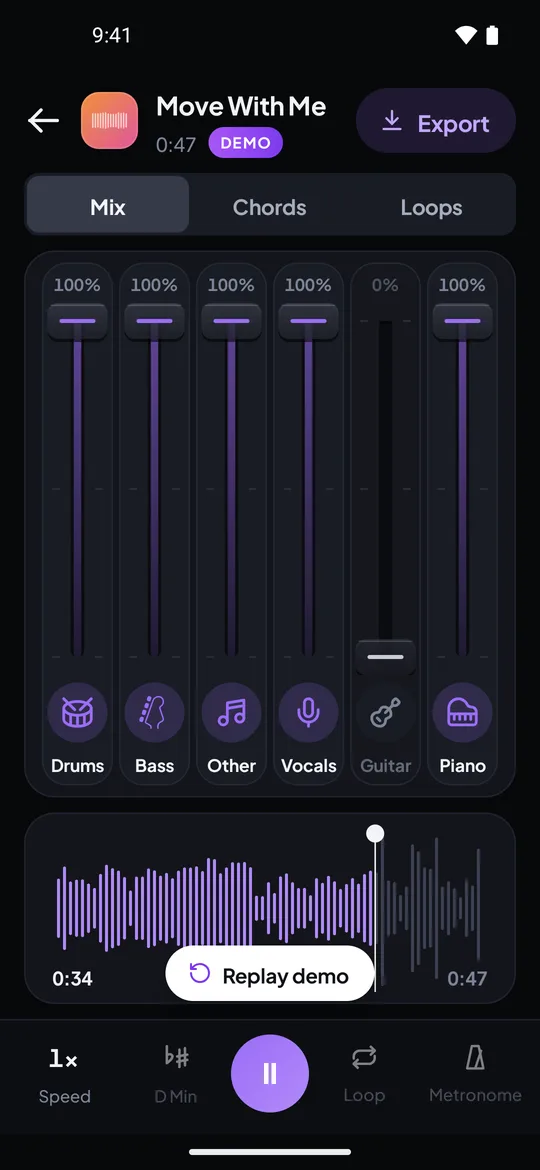
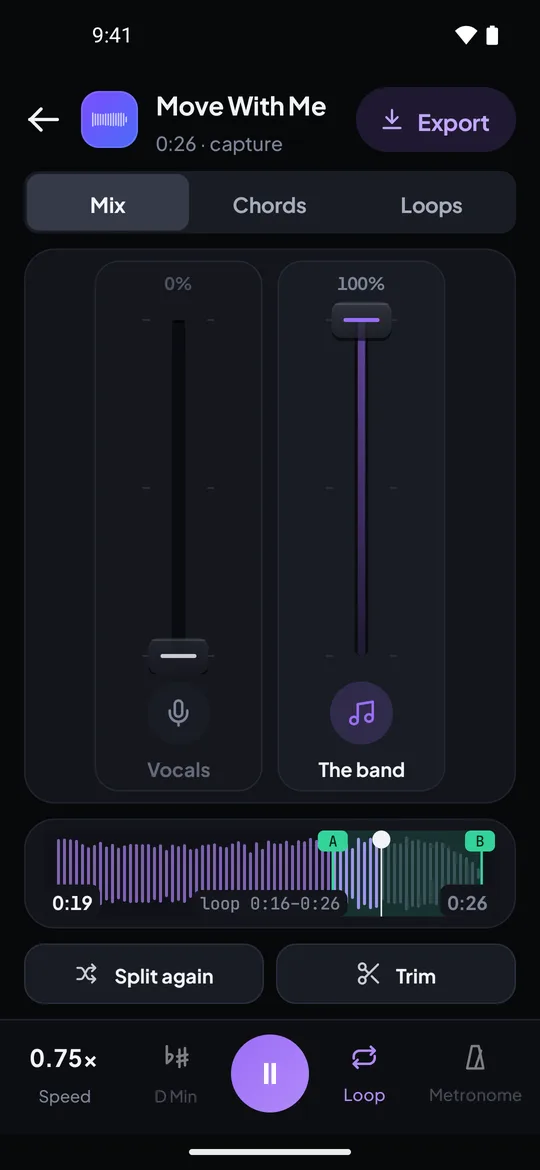
Real captures from the Riffloop Android app: the six-part mixer — pull any part down, including the bass — and a looped section at 0.75× speed.
That's the short version. For the full by-ear method — finding the root, root-and-fifth versus walking lines, ghost notes, slides and locking with the kick — read how to learn a bassline by ear. To make a play-along with the bass removed, use the backing track maker.
Honest Caveats Before You Start
An isolated bass is an estimate, not the original track: bass is one of the harder parts to separate, so expect a little kick drum or low guitar in it. Listen on headphones, learn one recording, and check notes by ear rather than trusting any one source.
- 🧪 Separation isn't perfect. AI stems are estimates; the kick and the bass share low frequencies, so some bleed is normal.
- 🎸 Not every "bassline" is a bass. Seven Nation Army is a guitar run through a pitch-shift pedal an octave down (Wikipedia); some riffs land in the guitar stem.
- 📀 Versions differ. Live takes, remasters and single edits can change the line — pick one recording and stick to it.
- 🎧 Speakers matter. Laptop and phone speakers barely play bass notes; use headphones.
- 🔢 Octaves fool the ear. If a note sounds right but feels wrong, try it an octave up or down on the neck.
Common Mistakes With Beginner Bass Songs
The usual mistakes are picking songs that are easy to play but hard to hear, practising too fast too soon, and learning the notes without the rhythm.
- Choosing by difficulty, not audibility. If you can't hear the bass, it isn't an easy song to learn by ear.
- Starting at full speed. Clean at 70% beats sloppy at 100%.
- Learning notes, not rhythm. The rests and note lengths are the groove — count them.
- Moving on too soon. Play the whole song with the band before you call it learned.
- Ignoring the drums. Keep the kick in your loop; the bass lives with it.
- Jumping to Level 3. An odd meter or a slinky riff is far easier once two or three Level 1 songs are solid.
Easy Bass Songs — FAQ
What beginner bass players ask about first songs: the easiest one, what to learn first, Seven Nation Army, practice speed, ear versus tabs, and how long it takes.
What is the easiest bass song to learn by ear?
Seven Nation Army by The White Stripes and Another One Bites the Dust by Queen are the usual first picks: each is one short riff, repeated for most of the song, at a comfortable tempo. Stand By Me is a close third, because its bass figure is exposed in a sparse arrangement. Pick whichever of the three you already know best — knowing the song is half the ear work.
What bass songs should a beginner learn first?
Start with songs that are one repeated riff or plain root notes at a slow or medium tempo — Seven Nation Army, Stand By Me, With or Without You, Zombie or Hit the Road Jack. Move on to riffs with more notes, such as Come As You Are or Billie Jean, once you can hold a line steady for a whole song.
Is Seven Nation Army played on a bass guitar?
No. On the record, the famous riff is Jack White's guitar through a pitch-shifting effect set an octave down; The White Stripes had no bass player. It's still one of the best first riffs to play on bass. If you isolate it, it may sit in the guitar stem rather than the bass stem.
What makes a bass song easy to learn by ear?
Five things: the bass is easy to hear (exposed in an intro or loud in the mix), the line repeats, it mostly plays chord roots, the tempo is slow or medium, and another instrument doubles it. The more of those a song has, the faster you'll pick it up.
Can a complete beginner learn bass songs by ear?
Yes, if the song is simple enough. A repeated riff or a root-note line is a good first ear-training exercise, because you only need to find a few notes and then repeat them. Isolate the bass, loop a short section and slow it down, and check each note on your fretboard by matching the pitch.
Should I learn bass songs by ear or from tabs?
Both have a place, but learning by ear builds the skill tabs can't: hearing a line and finding it on the neck. Tabs can also be wrong or describe a different version. A good compromise is to work the song out by ear first, then check your version against a source you trust.
Why is it hard to hear the bass in some songs?
Because it's low and often blended with the kick drum, and small speakers barely reproduce it. Use headphones or proper speakers, isolate the bass so the guitars and keys aren't masking it, and try humming the line an octave higher — your ear finds pitch more easily up there.
What speed should I practise a new bassline at?
Slow enough to play it cleanly — often around 70% for a new riff. Play it several times in a row without a mistake, then speed up in small steps of about 5% until you reach the original tempo. Slowing the song with the pitch held keeps the notes where they really are.
How long does it take to learn an easy bass song?
A single repeated riff like Seven Nation Army can take one practice session; a root-note song with a few chord changes can take a few days of short sessions to play all the way through in time. Songs on the stretch list can take a week or more. Short, daily practice is faster than one long session.
Are root-note songs good practice for beginners?
Yes. Playing chord roots in time is the core job of a bass player, and root-note songs train you to hear chord changes and lock with the drums. Once the roots are solid, adding passing notes and riffs is much easier.
Is Billie Jean easy to play on bass?
The notes are simple — one short pattern that repeats — but playing it evenly for the whole song is a real test of timing and stamina. That's why it's in the middle level here: easy to learn, hard to play perfectly.
What's an easy bass song in an odd time signature?
Pink Floyd's Money. The riff repeats, so it's easy to learn, but it's in 7/4 — seven beats to the bar — which makes it a good first step into odd meters. Count one to seven out loud while you loop a single bar.
Can I play along with the song without the original bass?
Yes. Mute the bass stem and keep everything else, and you have a play-along track where you are the bass player. Riffloop's backing track maker does exactly that, on a YouTube video or a file.
Is Another One Bites the Dust good for beginners?
Yes. The riff repeats through the song, it sits around the open E string so there's little moving around the neck, and it's loud in the mix. The challenge is the rests: count them and keep the gaps exact.
If You Remember Four Things
- 1 Easy by ear means audible, repeated, root-based and not too fast.
- 2 Start with one riff — Seven Nation Army, Another One Bites the Dust, Stand By Me.
- 3 Isolate the bass, loop it, slow it to 70%, then climb 5% at a time.
- 4 Finish by muting the bass and playing the part over the band.
Keep Going With Riffloop
Pick One Song. Loop the Riff.
Open a song from Level 1 on YouTube, solo the bass, loop the riff at 70% and play along — then mute the bass and take over. Three songs as a guest, no account.

